

- This event has passed.
6 Years Ari in Berlin-Moabit
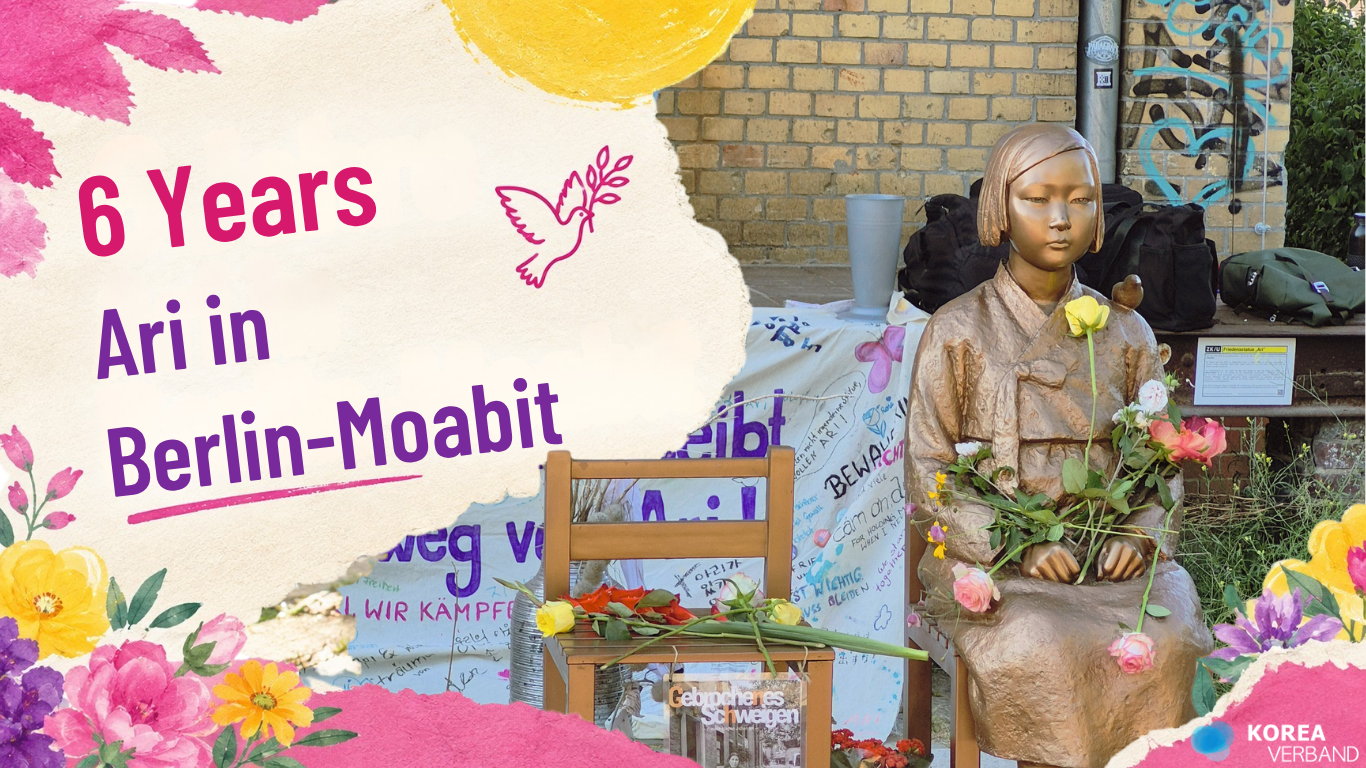
To mark the 6th anniversary of Ari’s installation in Berlin-Moabit, we would like to once again highlight its strong symbolic power in the fight against militarism and sexual violence.
The peace statue was set up in Moabit on the 28th of September in the year 2020. Just ten days later, as a result of political pressure from the Japanese government, the monument came under scrutiny by the Mitte District Office. For five years, together with many supporters, we successfully fought to prevent its removal.
One particularly meaningful experience in this long struggle was how much Ari’s significance grew through the people who stood with her in solidarity. Numerous artists supported out resistance with music, performances, literature and other forms of artistic expressions, thereby giving the memorial a peaceful yet powerful character. By our side were activists from all around the world as well as feminist scholars. In this way Ari grew beyond her original meaning, becoming a living place of remembrance, solidarity and resistance against sexualized violence, colonialism and militarism.
Once again, this year, a young musician and an internationally renowned scholar have joined us to honour Ari and the story she represents. With this event we aim to build a bridge between the history of the so called “Comfort Women” and the present. She reminds us, that sexualized violence in militarized contexts is not a closed chapter of the past.
On Sunday, the 27th of September, the musician Hyunsong Lee coning all the way to us from Stuttgart, will present her project “Resonant Absence – What remains unremembered?”. Through her musical work, she explores the things fading from our collective memory and what responsibility we bear to ensure that past injustices will not be forgotten.
This event will also be transmitted via Zoom:
The Korea Verband invites you to a planned meeting.
Topic: 6 Years Ari in Berlin-Moabit
Time: 27. Sept. 2026 05:00 PM Amsterdam, Berlin, Rom, Stockholm, Wien
Join the Zoom meeting
Join and take notes
Meeting-Chat-Link
Meeting-ID: 838 2609 8882
Passcode: 710351
“What remains” – A Marimba solo project about War and Memory
The project focuses on people whose experiences of war and violence have long been inadequately remembered or heard.
Particular emphasis is placed on the so-called “Comfort Women” as well as on veterans of the Korean War, whose stories are an important part of Korean history. This project was inspired by interviews with survivors of the so-called “Comfort Women” as well as personal encounters with veterans of the Korean War during my stay in Germany. These encounters prompted me to explore, through my art, the question of how memory can be passed on and what role music can play in this process.
This project was funded as a grant project at the State University of Music and Performing Arts in Stuttgart.
The program is structured as a solo marimba concerto lasting approximately 20-30 minutes and seeks to make the traces of memory, time and emotions audible through music.
Program
Marimba solo project (about 20 to 30 minutes)
J. S. Bach – Chaconne in D minor (from Partita No. 2)
Johann Sebastian Bach’s Chaconne is one of the most impressive works in music history. Building on a brief harmonic foundation, Bach develops a series of variations that continually unfold and evolve.
In this project, the Chaconne symbolizes the passage of time and the return of memory. The deep, warm timbre of the marimba opens a new perspective on this work and forms the central musical core of the program.
Jean Sibelius – Kuusi (The Spruce)
Jean Sibelius’s piece “Kuusi” is characterized by a calm and meditative atmosphere. Rather than dramatic developments, the musical tension here arises from subtle changes in timbre and melody.
Within the program, this work feels like a moment of quiet reflection. The marimba makes it possible to conveys this fragile and pensive mood with particular sensitivity.
Arirang Arrangement for Marimba
Arirang is one of Korea’s best-known traditional songs and is often understood as a musical symbol of collective memory and emotional experience.
In the context of this program, Arirang represents the connection between individual and cultural memory. Through its interpretation on the marimba, this melody takes on a new tonal dimension and provides a calm, contemplative conclusion to the program.
Artist Biography
Hyunsong Lee is a drummer and is currently pursuing a master’s degree at the State University of Music and Performing Arts Stuttgart.
She also completed her bachelor’s degree at the HMDK Stuttgart. As a musician, she has performed in various countries, including Korea, Taiwan, the Netherlands, France, Norway, and Germany.
In her artistic work, she views percussion instruments not merely as rhythmic instruments, but as an artistic medium for expressing social themes and emotions. She is particularly interested in projects that explore memory, history, and social issues.
Her current project, “Was bleibt” (What Remains), is a marimba solo project about war and memory and was funded as a scholarship project at the State University of Music and Performing Arts Stuttgart.
Following the musical performance, Prof. Dr. Margo Okazawa-Rey will give a lecture in English:
“Military Sexual Slavery and Violence: Same Old Patriarchal Game Plan”
Military sexual slavery and sexualized violence are neither new nor surprising. Violence against and exploitation of women by national armed forces and local militia are an integral part of war, militarism and militarization, but they exist in different proportions. However, their specific forms vary depending on the location and historical context; in some places, clear patterns of continuity can be observed.
Such a line of continuity exists between the system of sexual enslavement by the Japanese Imperial Army – the so-called “Comfort Women” system – and the structures that were adopted and continued by the U.S. and South Korean governments during the Korean War and in the period that followed. This includes the so-called “Kijichon women” prostituted at military bases and in the surrounding towns, where women were, and continue to be, made available to U.S. military personnel for prostitution.
In every case, poor, working-class, rural women are consistently targeted and victimized, and the “sponsors” – the governments and their militaries, local small businesses located around the military bases, and sometimes families of the women – benefit, although in minute ways. The demographics of the women change as the economic conditions change. In the case of Korea, it used to be mostly Korean Women; today, they are often women from the Philippines and Thailand. Same old system; different women.
The purpose of the conversation is to highlight the connections between these different historical and contemporary situations. At the same time, it aims to show how feminists have organized and resisted these systems, and how survivors themselves have become active and self-determined actors.
Profile of Margo Okazawa-Rey
Margo Okazawa-Rey, Professor Emerita San Francisco State University, is an activist-educator working and writing bout issues of militarism, militarization and violence against women for over 30 years.
She has long-standing activist and relational commitments outside the US shape her thinkings, understandings, and political perspective, especially politics of transnational feminist solidarities.
She is a founding member of the International Women’s Network against Militarism and Women for Genuine Security, its US group and the 1970s Black feminist Combahee River Collective.
She also produces and hosts feminist radio program Women’s Magazine, broadcasted on KPFA Berkely California station of the Pacifica Radio network, and is known as DJ MOR Love and Joy, transnational feminist virtual dance party DJ.
Her recent publications include:
“Feminist Visions for Genuine Security and a Culture of Life: A Conversation with Margo Okazawa-Rey with Suzy Kim”, positions, Vol. 34, Nr. 2, May 2026;
“Afterword”, in: We Are Each Other’s Liberation: Black and Asian Feminist Solidarities, Swift, Tso & Kuo, Chicago: Haymarket Books, 2025;
“A Report from the Bahamas: And What of Identity Politics?”, in: This Unruly Witness: June Jordan’s Legacy, Muller, Thompson, Hill et al, Chicago: Haymarket Books, 2025.
This post is also available in Deutsch.